There are few things more frustrating on laundry day than opening the dryer and finding your clothes just as damp and cold as when you put them in. If your dryer tumbles, spins, and even makes all the right noises but simply refuses to produce heat, you’re dealing with one of the most common — and most misunderstood — appliance problems in Abu Dhabi homes.
The good news? A dryer that won’t heat up is rarely a sign that the whole unit is dead. In most cases, the drum motor is working perfectly fine, and the real issue is a single, isolated component that has failed. The challenge is knowing which component, because a dryer can lose its heat for eight or nine completely different reasons — and only a handful of them are safe for a homeowner to check without professional help.
In this guide, we’ll walk through exactly why your dryer isn’t heating, how to narrow down the cause room by room, which fixes are DIY-friendly, and when it’s time to call in a certified technician. If you’re anywhere in Abu Dhabi and your dryer has gone cold, our team at Appliances Fix Abu Dhabi is a phone call away.
The Most Common Reasons a Dryer Not Heating Up
Before we go deep into diagnostics, here’s the short version. If your dryer isn’t heating, the culprit is almost always one of these:
- A blown thermal fuse
- A burnt-out heating element
- A tripped circuit breaker or blown fuse (electric dryers) or a closed gas valve (gas dryers)
- A faulty thermostat or cycling thermostat
- A clogged lint filter or exhaust vent
- A broken igniter (gas dryers only)
- A failed timer or control board
- A defective high-limit thermostat
Let’s break each of these down in detail, along with what causes them and how they’re typically diagnosed and fixed.
1. Clogged Lint Filter or Vent — The #1 Cause
Before assuming a part has failed, check the simplest thing first: airflow. Dryers rely on a steady stream of air moving through the drum to carry heat and moisture out through the exhaust vent. When lint builds up in the filter or the vent hose becomes blocked (often with a bird’s nest, crushed ducting, or years of compacted lint), the dryer’s safety systems can shut off the heating element to prevent overheating — even though everything else appears to be running normally.
Signs it’s the vent:
- Clothes take much longer than usual to dry, even if some heat is present
- The dryer feels unusually hot to the touch on the outside
- A burning smell during operation
- The room gets noticeably more humid than before
Fix: Clean the lint trap after every load, and have the exhaust duct professionally inspected and cleaned at least once a year. This single habit prevents a huge share of the heating complaints we see across refrigerator, washing machine, oven, and dryer repair calls we handle across Abu Dhabi.
2. Blown Thermal Fuse
The thermal fuse is a small, one-time-use safety device designed to cut power to the heating element if the dryer overheats — usually because of restricted airflow (see cause #1). Unlike a thermostat, a thermal fuse cannot reset itself once it blows; it must be replaced.
Signs it’s the thermal fuse:
- The drum tumbles normally, but there is zero heat, even on the hottest setting
- The dryer previously overheated or had a vent blockage
Fix: This requires opening the dryer cabinet and testing the fuse with a multimeter for continuity. Because thermal fuses often blow as a result of a vent problem, replacing the fuse without clearing the underlying airflow issue means it will likely blow again. This is one of the most frequent reasons our technicians get repeat calls from customers who tried a DIY fuse swap without addressing the root cause.
3. Burnt-Out Heating Element
The heating element is the coil (electric dryers) that actually generates the heat. Over years of use, the coil can corrode, stretch, or break — much like an old light bulb filament finally giving out.
Signs it’s the heating element:
- No heat at all, but the dryer runs, tumbles, and the timer advances normally
- You may notice the element visually broken or discolored if you can safely inspect it
Fix: A failed heating element must be replaced with the correct part number for your make and model. This is a job best left to a professional, since it involves working near live electrical components and, in many units, partially disassembling the drum housing. Our team handles this as one of the most requested repairs across every neighborhood we service — see our dedicated dryer repair guide for more detail on how we diagnose it.
4. Tripped Breaker, Blown Fuse, or Closed Gas Valve
Electric dryers typically run on a 220–240V circuit with two legs of power. One leg powers the drum motor and controls (which is why the dryer still “runs”), while the other powers the heating element. If one leg trips at the breaker panel, the dryer will spin and tumble but never heat.
For gas dryers, a closed gas supply valve or a tripped gas shut-off will produce the exact same symptom: normal tumbling, no heat.
Fix:
- Check your electrical panel for a tripped double-pole breaker
- For gas dryers, confirm the gas supply valve behind the unit is fully open
- If the breaker trips repeatedly, do not keep resetting it — this can indicate a wiring fault that needs professional attention
5. Faulty Thermostat or Cycling Thermostat
Dryers use one or more thermostats to regulate temperature throughout the cycle — cutting the heating element on and off to maintain the right drying temperature. When a thermostat fails, it can either stop signaling the heater to turn on at all, or cause it to short-cycle so quickly that clothes never actually dry.
Signs it’s the thermostat:
- Heat starts but cuts out early
- The dryer runs hot for a moment and then goes cold
- Uneven or inconsistent drying results, load after load
Fix: Thermostats are tested with a multimeter and replaced individually. Because there are often two or three thermostats in a single dryer (cycling, operating, and high-limit), correctly identifying the failed one saves time and money — something our technicians specialize in during every appliance maintenance visit.
6. Broken Igniter (Gas Dryers Only)
If you have a gas dryer, the igniter is responsible for lighting the burner that produces heat. Igniters weaken gradually over years of cycling on and off, and eventually stop glowing hot enough to ignite the gas.
Signs it’s the igniter:
- You may hear the gas valve click or hiss briefly, followed by silence, with no flame or heat
- The dryer runs its full cycle but clothes stay cold
Fix: Gas dryer components should always be diagnosed and replaced by a trained technician, given the safety risks involved with gas lines. If you smell gas at any point, stop using the dryer immediately, ventilate the area, and contact a professional.
7. Failed Timer or Control Board
On modern dryers, the timer or electronic control board manages when and how long the heating element receives power. A failing board or worn-out timer motor can prevent the heat circuit from ever being triggered, even though every other function works.
Signs it’s the control board:
- Buttons or dial don’t respond consistently
- The display shows error codes
- Heat works on some cycles but not others
Fix: Control boards are diagnosed with specialized testing and, when confirmed faulty, replaced as a unit. This is typically one of the pricier dryer repairs, so a second opinion — and a proper diagnosis ruling out cheaper causes first — is always worthwhile.
8. Defective High-Limit Thermostat (Safety Cutoff)
Separate from the regular cycling thermostat, the high-limit thermostat is a safety component that shuts off the heater if internal temperatures climb dangerously high — often triggered by the same airflow problems mentioned in cause #1. If this component fails in the “open” position, it can permanently block heat even after the vent is cleared.
Fix: Like the thermal fuse, this should be tested for continuity and replaced if it has failed, ideally at the same time any vent blockage is cleared.
DIY Checklist Before You Call a Technician
If your dryer suddenly stopped heating, run through this quick checklist first — it takes less than ten minutes and solves a surprising number of cases:
- Clean the lint filter completely
- Check that the exhaust vent isn’t crushed, disconnected, or blocked
- Confirm the breaker hasn’t tripped (check both legs for electric dryers)
- For gas dryers, confirm the gas supply valve is open
- Make sure the dryer door is closing fully (a faulty door switch can also stop heat)
- Try a shorter, different cycle to rule out a program-specific glitch
If none of these resolve the issue, the problem is almost certainly internal — a blown fuse, failed element, faulty thermostat, or control board issue — and it’s time to bring in a professional rather than risk further damage or an electrical hazard.
Why You Shouldn’t Ignore a Dryer That Won’t Heat
Beyond the obvious inconvenience, a dryer with restricted airflow or a failing safety component is one of the more common sources of home appliance fires. According to the National Fire Protection Association, failure to clean dryers is a leading factor in home clothes dryer fires. That’s precisely why several of the “common causes” above — the thermal fuse, the high-limit thermostat, and vent blockages — exist as layered safety systems in the first place. If your dryer stopped heating right after it felt unusually hot, that’s not a coincidence to ignore.
On the efficiency side, a dryer that’s struggling to heat properly also uses more electricity per load as it runs longer cycles trying to compensate. Resources like ENERGY STAR highlight how well-maintained appliances consistently use less energy than neglected ones — another reason routine maintenance pays for itself over time, a topic we cover in more depth in our guide on why regular appliance maintenance saves you money.
When to Call a Professional Dryer Repair Technician
Some dryer issues are safe for confident homeowners to check themselves — cleaning lint, checking a breaker, confirming a gas valve is open. But anything involving the following should be left to a certified technician:
- Testing or replacing electrical components (thermal fuse, thermostats, heating element)
- Any work involving the gas line or igniter assembly
- Diagnosing or replacing a control board
- Situations where you’ve smelled burning, seen scorch marks, or noticed sparking
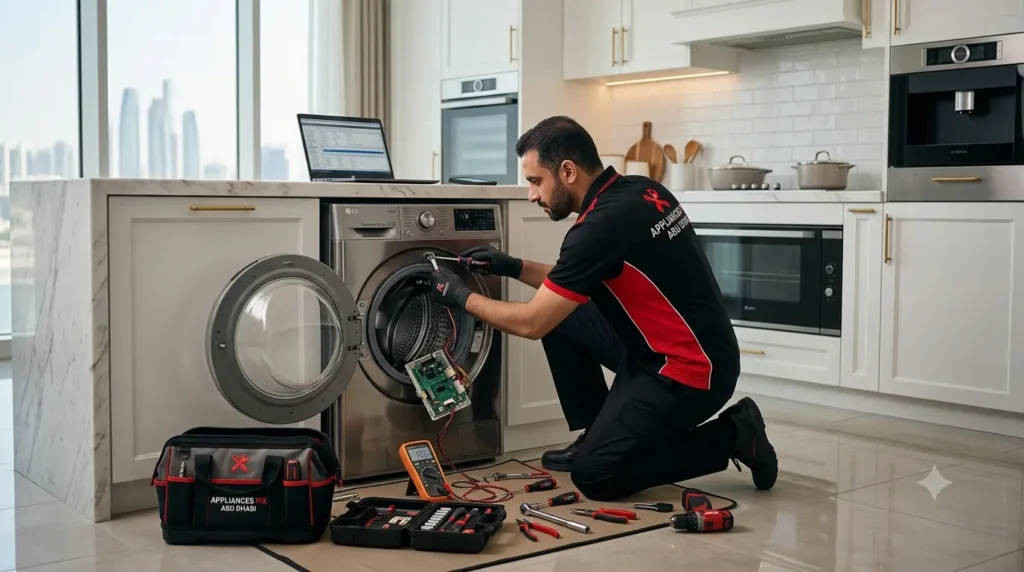
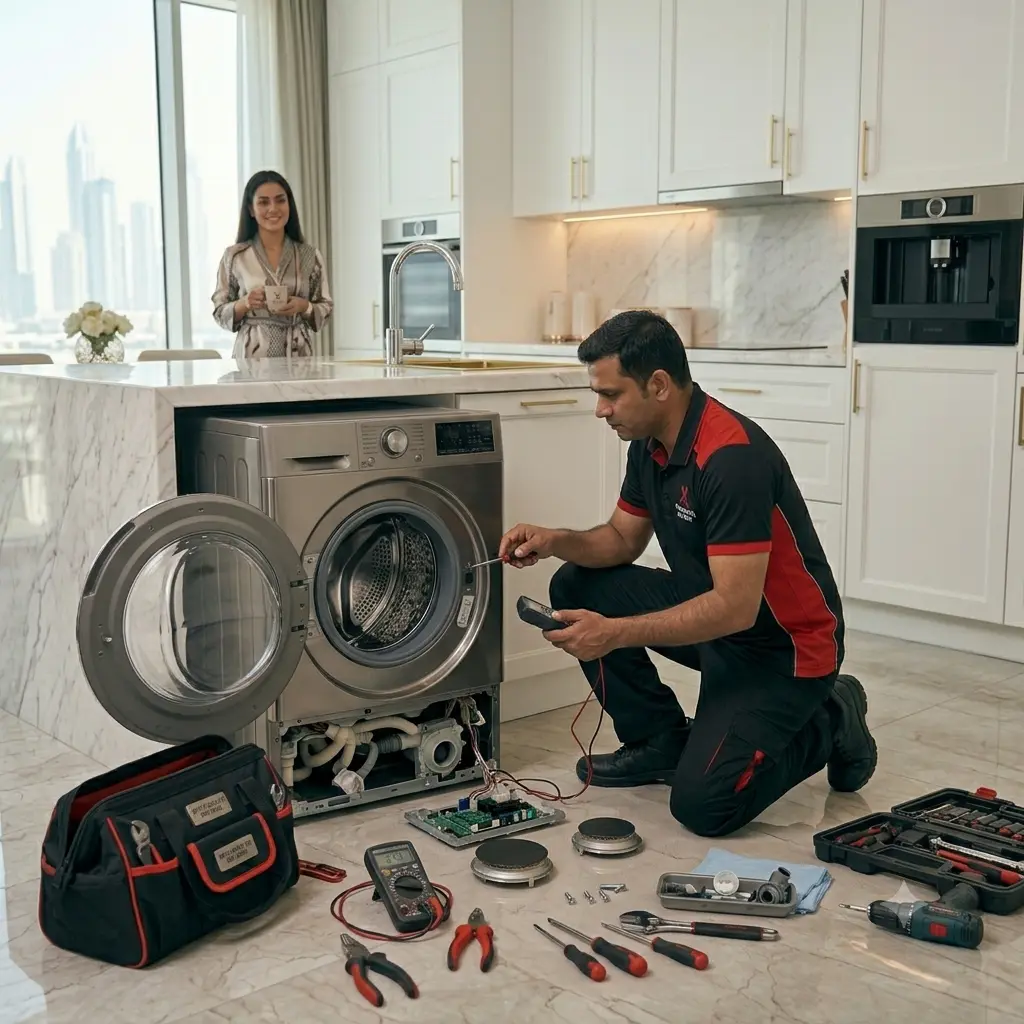
At Appliances Fix Abu Dhabi, our technicians carry the multimeters, replacement parts, and manufacturer know-how to diagnose the exact cause on the first visit — not guess and swap parts one at a time. We service all major brands and offer same-day appointments across the emirate.
Areas We Cover for Dryer Repair in Abu Dhabi
We provide fast, same-day dryer repair across the city and surrounding communities, including:
City Center & Downtown:
Al Danah · Al Zahiyah · Al Markaziyah · Tourist Club Area · Al Meena · Corniche & Murror Street · Al Khaldiya
Residential Communities:
Al Manhal · Al Nahyan · Al Marina · Al Khubeirah · Al Tibbiya · Al Rowdah · Al Qurm · Al Reef Downtown · Al Reef Villas
Outer Communities:
Madinat Zayed · Zayed City · Al Samha · Al Wathba · Eastern Mangrove · Danet Abu Dhabi · Sas Al Nakhl
Islands:
Yas Island · Saadiyat Island · Reem Island · Al Maryah Island · Lulu Island · Hudayriyat Island · Nurai Island · Jubail Island
Not sure if we cover your exact area? Contact us and we’ll confirm availability and give you a same-day time slot.
Other Appliances Not Working Right?
If your dryer isn’t the only appliance giving you trouble, we handle full-home appliance repair across Abu Dhabi, including:
- Refrigerator repair — including our detailed guide on why your fridge isn’t cooling
- Washing machine repair — see also why your washing machine won’t drain
- Oven and cooker repair
- Dishwasher repair
- Small appliance repair
Frequently Asked Questions
Q: My dryer runs and tumbles but doesn’t heat at all. What’s the most likely cause?
A: In most homes, it’s either a blown thermal fuse (often triggered by a clogged vent) or a burnt-out heating element. Both are common, both are fixable, and both are best confirmed with a multimeter test rather than guesswork.
Q: Can I fix a dryer heating problem myself?
A: Simple checks — cleaning the lint filter, checking the vent, and confirming your breaker or gas valve — are safe for most homeowners. Anything involving opening the cabinet, testing electrical parts, or gas components should be handled by a certified technician for safety reasons.
Q: How often should I clean my dryer vent to prevent this?
A: At least once a year for average household use, and more often if you do frequent large loads or have a long or bent duct run to the exterior.
Q: Is a dryer that won’t heat dangerous?
A: The lack of heat itself isn’t dangerous, but the underlying cause — especially a blocked vent — is one of the leading contributors to home dryer fires. It’s worth having it checked promptly rather than living with cold laundry for weeks.
Q: How quickly can Appliances Fix Abu Dhabi come out?
A: We offer same-day appointments across most of Abu Dhabi, including the islands and outer communities. Get in touch to schedule a visit.
Q: Do you repair both gas and electric dryers?
A: Yes, our technicians are trained and equipped to diagnose and repair both gas and electric dryer models from all major brands.
Final Thoughts
A dryer that won’t heat is almost never a reason to replace the whole unit — it’s usually one small, identifiable part that has simply reached the end of its life or is being tripped by a safety system doing exactly what it’s designed to do. Start with the basics (lint filter, vent, breaker, gas valve), and if the problem persists, get a proper diagnosis rather than swapping parts by guesswork.
If you’re anywhere in Abu Dhabi and your dryer has gone cold, the team at Appliances Fix Abu Dhabi is ready to help with same-day, technician-verified repairs — backed by genuine parts and clear, upfront pricing. Browse more appliance guides on our blog or reach out directly to book your visit today.