You load the washer, press start, walk away, and come back expecting clean clothes — instead you find a machine full of dirty, soapy water that refuses to go anywhere. A washing machine not draining water is one of the most common appliance complaints homeowners across Abu Dhabi report, and the good news is that in most cases, it’s fixable without buying a brand-new machine.
In this guide, we’ll walk you through exactly why your washing machine won’t drain, simple checks you can do yourself, professional fixes, and how to prevent this problem from happening again. Whether you own a front-load or top-load washer, this article covers it all.
If at any point the issue feels beyond a DIY fix, our team at Appliances Fix Abu Dhabi offers same-day washing machine repair in Abu Dhabi — fast, affordable, and backed by experienced local technicians.
Why Is It Important to Fix a Non-Draining Washing Machine Quickly?
Ignoring a washing machine that won’t drain doesn’t just mean wet, heavy laundry stuck in the drum. Standing water can lead to:
- Mold and bad odor building up inside the drum and rubber gasket
- Electrical hazards, since water pooling near electrical components is dangerous
- Motor and bearing damage from the machine trying to force a spin cycle with a full drum
- Higher water and electricity bills from repeated failed cycles
- Floor and property damage if water overflows
Acting quickly not only saves your clothes but also protects your machine from more expensive damage down the line. This is exactly the kind of issue we talk about in our article on why regular appliance maintenance saves you money — small problems, left unattended, almost always become big ones
Common Causes of a Washing Machine Not Draining Water
Let’s break down the most frequent reasons behind this problem, starting with the simplest and most common.
1. Clogged Drain Filter
Nearly every modern washing machine has a small drain filter (also called a pump filter or lint filter), usually located behind a small panel at the bottom front of the machine. Over time, this filter traps coins, hair, lint, buttons, tissue paper, and small fabric fibers. Once it’s full, water simply cannot pass through.
Signs it’s the filter: Slow draining, gurgling sounds, or a foul smell coming from the machine.
2. Blocked or Kinked Drain Hose
The drain hose carries water from the machine to your home’s drainage system. If it’s kinked, twisted, or blocked with debris (soap scum, small clothing items, or mineral buildup), water flow gets restricted or stopped completely.
Signs it’s the hose: Water drains partially but very slowly, or drains fine on some cycles and not others.
3. Faulty Drain Pump
The drain pump is the component responsible for physically pushing water out of the machine. If it burns out, jams, or gets clogged with debris like coins or small objects, the machine won’t drain at all.
Signs it’s the pump: A humming sound with no water movement, complete silence during the drain cycle, or a burning smell.
4. Broken or Stuck Lid/Door Switch
Many washing machines won’t complete a drain or spin cycle if the door/lid switch isn’t sending the correct signal that the door is securely closed. A faulty switch can trick the machine into thinking the door is open, halting the cycle.
Signs it’s the switch: The machine stops mid-cycle, or the door won’t lock properly.
5. Clogged Drainage Pipe (Home Plumbing Issue)
Sometimes the washing machine itself is working perfectly fine — the blockage is actually in your home’s drainage pipe or the standpipe the washer connects to. This is especially common in older buildings across Abu Dhabi with aging plumbing systems.
Signs it’s the pipe: Water backs up into the machine, or you notice slow drainage in nearby sinks too.
6. Faulty Control Board or Timer
In rare cases, the electronic control board or timer that manages the wash cycle malfunctions and fails to trigger the drain function altogether, even though every mechanical part is working correctly.
Signs it’s the control board: The machine behaves erratically — skipping cycles, freezing, or displaying error codes.
7. Overloading the Machine
Stuffing too many clothes into a single load can prevent proper water circulation and drainage, especially in front-load machines where balance and spacing matter more.
Signs it’s overloading: The issue only happens with large loads, and the machine drains fine with smaller ones.
8. Faulty Drain Belt (Top-Load Machines)
Older top-load washers use a belt-driven pump system. If this belt becomes loose, worn, or snaps, the pump won’t spin fast enough (or at all) to push water out.
Signs it’s the belt: A burning rubber smell, a whining noise, or a visible loose belt when the panel is opened.
Step-by-Step Fixes You Can Try at Home
Before calling a technician, there are a few safe checks you can do yourself. Always unplug the washing machine before inspecting any internal parts.
Fix 1: Clean the Drain Filter
Locate the small access panel near the bottom front of your machine, place a shallow tray underneath (residual water will spill out), unscrew the filter cap slowly, and remove any trapped debris. Rinse the filter under running water and reinstall it firmly.
Fix 2: Check and Straighten the Drain Hose
Pull the machine slightly away from the wall and inspect the hose for kinks, bends, or visible blockages. Disconnect it carefully and run water through it to check for clogs. Reconnect securely once clear.
Fix 3: Test the Door/Lid Switch
Open and close the door a few times, listening for a clear click. If the door doesn’t latch properly or feels loose, the switch may need replacement — this is a quick fix for a technician.
Fix 4: Reduce Load Size
If the problem only happens with large loads, try washing smaller batches for a few cycles to see if drainage improves. If it does, the issue is likely related to overloading or a slightly weakened pump that needs inspection.
Fix 5: Check Your Home Drainage Point
Run water directly into the sink or standpipe the washer drains into. If it drains slowly there too, the blockage is in your home plumbing, not the washing machine — you may need a plumber alongside your appliance technician.
Fix 6: Listen for the Pump
Start a drain cycle and listen closely. A loud humming noise with no water movement usually points to a jammed or failing pump — this typically requires professional replacement.
When Should You Call a Professional?
While filter cleaning and hose checks are safe DIY tasks, the following situations need a trained technician:
- Drain pump replacement
- Control board or timer diagnostics and repair
- Internal wiring or electrical faults
- Drain belt replacement
- Persistent draining issues after trying all DIY steps
- Any repair involving disassembling the machine’s internal housing
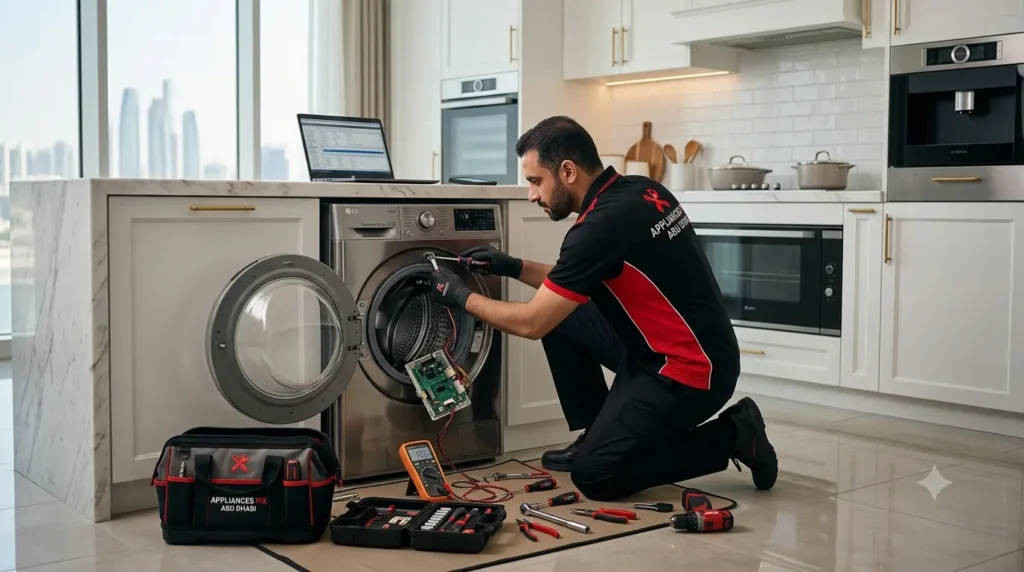
Attempting complex repairs without experience can void your warranty, cause further damage, or create safety risks. Our licensed technicians at Appliances Fix Abu Dhabi diagnose the exact cause on-site and carry genuine spare parts for most major brands, meaning most washing machine repairs are completed in a single visit.
How to Prevent Future Drainage Problems
A little regular maintenance goes a long way in avoiding repeat visits and costly repairs:
- Clean the drain filter every 4–6 weeks, especially if you frequently wash items with pockets
- Empty pockets before washing to avoid coins, tissues, and small items entering the pump
- Avoid overloading the drum beyond the manufacturer’s recommended capacity
- Use the correct detergent type and quantity — too much detergent causes excess suds that strain the drain pump
- Check the drain hose position periodically to ensure it isn’t kinked or pinched behind the machine
- Schedule annual professional maintenance to catch worn belts, pumps, or electrical issues before they cause a breakdown
For a deeper look at how proactive care extends appliance lifespan and saves money, check out our related post: Why Regular Appliance Maintenance Saves You Money.
Areas We Cover in Abu Dhabi
Appliances Fix Abu Dhabi provides same-day washing machine repair across the city and surrounding communities, including:
- Al Khubeirah
- Al Markaziyah
- Al Manhal
- Al Nahyan
- Al Rowdah
- Al Marina
- Danet Abu Dhabi
- Madinat Zayed
- Zayed City
- Al Samha
- Al Wathba
- Eastern Mangrove
Not on this list? We still likely cover your area — contact us to confirm availability and book a technician.
We also repair other major home appliances, including refrigerators, dryers, dishwashers, ovens and cookers, and small appliances.
Frequently Asked Questions (FAQ)
Q1: Why is my washing machine filling with water but not draining?
This is almost always caused by a clogged drain filter, a blocked drain hose, or a failing drain pump. Start by checking and cleaning the filter — it resolves the issue in most cases.
Q2: Is it safe to use a washing machine that won’t drain?
No. Continuing to run cycles on a machine that isn’t draining properly can damage the motor, cause water damage, and create electrical hazards. Stop using the machine and address the issue first.
Q3: How much does it cost to fix a washing machine that’s not draining?
Costs vary depending on the cause — a simple filter cleaning is inexpensive, while a drain pump or control board replacement costs more. Contact us for a free, no-obligation quote based on your machine’s brand and model.
Q4: Can I fix a washing machine drainage issue myself?
Basic checks like cleaning the filter or straightening the drain hose are safe for most homeowners. However, pump replacement, electrical diagnostics, and internal repairs should always be handled by a trained technician.
Q5: How often should I clean my washing machine’s drain filter?
We recommend cleaning it every 4 to 6 weeks under normal use, or more frequently if you regularly wash items with pockets or pet hair.
Q6: Do you offer same-day washing machine repair in Abu Dhabi?
Yes. Appliances Fix Abu Dhabi offers same-day service across Abu Dhabi city and surrounding areas, with technicians carrying common spare parts to complete most repairs in a single visit.
Final Thoughts
A washing machine not draining water is frustrating, but it’s rarely a reason to replace the entire appliance. In most cases, the root cause is something simple — a clogged filter, a kinked hose, or a worn-out pump — all of which are repairable quickly and affordably by an experienced technician.
If you’ve tried the DIY steps above and your washing machine is still holding water, don’t risk further damage. Get in touch with Appliances Fix Abu Dhabi today for a fast diagnosis and same-day repair. Our team has helped hundreds of households across Abu Dhabi get their laundry routine back on track — and we’re just a call away.
📞 Book your washing machine repair today: appliancesfixabudhabi.com 🔧 Explore more repair guides: Visit our Blog